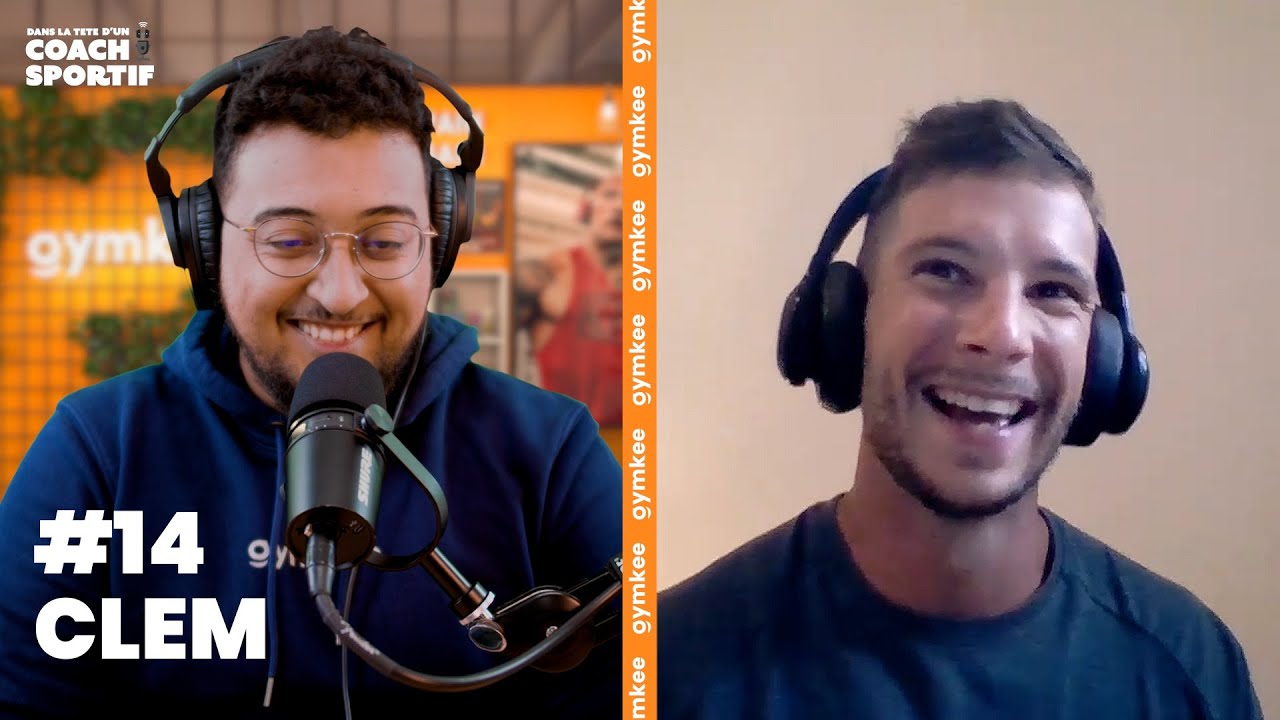
Clem: Live Anywhere Through Online Coaching
Clem's 29. He's been coaching since 2017. He recorded this episode from Bali, in swim trunks under his t-shirt, fresh off an improvised four-day trip into the island's interior. That's what online coaching looks like when it's done right: you work from wherever you want, you generate recurring revenue from your laptop, and you can take off for four days on a whim because your business doesn't need you standing in a gym from 7am to 8pm.
Before coaching, Clem worked over 40 different jobs. Temp agencies, restaurants, warehouse picking, organic grocery cashier. He was a hardcore gamer who spent up to 14 hours a day on video games. The gym changed everything for him. He was skinny fat when he started, got results, and figured if he could do it, other people could too. He completed two BPJEPS certifications (one through an apprenticeship with Pierre et Vacances), launched online coaching in 2017 before it was trendy, and moved to Dubai on a whim in late 2021 with his diploma rush-translated, coaching in gyms where half the people there were coaches with their clients.
This episode kicks off season 2 of the podcast with someone who's done everything in the right order but the wrong sequence: online coaching before in-person, in-person in Dubai after two years online, back to France, and now Bali. What comes through is a crystal-clear vision of the profession: structure to optimize, cap your one-on-one clients, build content to reach more people, and create a business that sets you free instead of chaining you down.
What You'll Learn in This Episode
-
Starting in 2017, when online coaching barely existed
Clem launched his first online coaching in 2017, back when people still thought of coaching as a luxury and couldn't wrap their heads around being coached remotely. His first client found a parody video he'd made with a friend ("Les Bras Casses")... dressed up as fit girls, poking fun at fitness cliches. She loved the humor, became his first client. Then she became his girlfriend. He fully owns the cliche. In 2017, there wasn't a Basic-Fit on every corner yet. He built everything while working side jobs, warehouse shifts, restaurant gigs, to fill the gaps until coaching took over.
-
The Dubai experience: another world, a decade ahead
Late 2021, second Covid wave, everything shut down in France... Dubai was open. Clem left on a whim, got his diploma rush-translated at the consulate. First day in a gym over there: 14 people, 7 coaches with their 7 clients. Half the room was coaches, on a random afternoon. In France, you walk into a Basic-Fit and suggest someone get a coach, they laugh at you. In Dubai, it's the norm. He was charging 100 to 120 euros an hour there, and his colleagues were pulling in up to 400. Coaches in Dubai "drive Ferraris and Lamborghinis." But he still chose to come back and focus on content, because coaching 7 days a week in a gym, even with great pay, wasn't what he wanted to build long-term.
-
Raising prices gradually and being upfront about increases
Clem started at 60 euros a month. He raises his rates gradually, every year. At the time of the episode, he was at around 200 euros a month, with 1, 3, or 6-month packages. He announced during the episode that he'd be raising rates on January 1st, and people who've been following him for a while expect it at this point. His rule for existing clients: he doesn't change their price mid-contract. New clients get the new rate. It naturally creates loyalty and healthy turnover.
-
The goal: under 10 one-on-one clients to focus on content
Clem's moving toward fewer individual coaching clients. His goal for the following year: 10 clients max, with rates adjusted upward. The reason's simple: he wants to go all in on content creation. He launched an online weight-loss course (videos, modules) to build passive income. His TikTok with his girlfriend's past 200,000 followers. He films in Bali during his trips. He optimizes everything... even a restaurant meal can turn into a video that "pays for the meal." It's not content obsession, it's the logic of someone who figured out that content is his number one asset.
-
Online coaching beats in-person for real human connection
Clem's blunt about this: one-on-one online coaching has more long-term impact than in-person, because you're present 7 days a week in your client's life. In a gym, you've got one hour. Online, the client sends you a TikTok that reminded them of you, you send a message when they had a great day, you're there for the highs and the lows. The mental support side of things is way more developed online than in-person. And for anyone who's on the fence about making the switch, he keeps it simple: "Seriously, don't hesitate. It works."
-
Create content for credibility, not for going viral
Clem makes two kinds of content: fun videos and exercise correction videos. The fun stuff gets the views, brings in followers, but doesn't convert directly to paying clients. Exercise corrections get fewer views... but that's where he shows his professional vocabulary, his technical chops, his credibility. "Viral posts are cool, they're good for the ego. But they're not what brings clients." You need both: volume for visibility, and expert content for conversion.
-
YouTube for the long game, short-form for the short-term algorithm
Clem's all in on YouTube. A single video can bring you a client two years after you publish it. TikTok? That's 24 hours and it's gone. He points to Gymkee as proof: "You guys run primarily on YouTube, no salespeople, no ads." So his strategy's clear: create long-form content on YouTube, then chop it into short formats for Instagram, TikTok, YouTube Shorts. In Bali, he filmed a free bodyweight and resistance band training course to use as a lead magnet. He thinks about everything through the lens of optimization.
-
Tools: keep it simple, centralize, skip the unnecessary stacking
Clem's a minimalist when it comes to tools. For managing clients: Total Coaching (he's used it since Dubai) and WhatsApp. For content: Canva on desktop, a DSLR camera for video, and dynamic edits he handles himself. He's genuinely good at editing, he's been doing it for years, and it's one of his real competitive advantages. He stresses video quality as something that sets you apart from other coaches. "Shot with a high-end DSLR, dynamic edits... people notice that right away."
Resources Mentioned
- BPJEPS, two certifications completed by Clem: strength training (private school) and group classes + APAS (apprenticeship with Pierre et Vacances)
- Pierre et Vacances, company where Clem completed his second BPJEPS as an apprentice
- Dubai: Binous Gym, Seven Gym, gyms he trained at during his stay
- Total Coaching, online coaching app he's used since Dubai
- WhatsApp for daily client communication
- Canva for creating visual content
- TikTok, account with his girlfriend approaching 200,000 followers
- YouTube as his preferred platform for long-term content
- Coach Bras Casse, Clem's Instagram handle, from the "Les Bras Casses" account he started with a friend
- Gymkee mentioned as a platform that grows through YouTube without ad spend
"I just got back from a completely improvised four-day trip deep into Bali. I do what I want, I can work from wherever I want. You can't put a price on that."
"First day in a gym in Dubai: 14 people, 7 coaches with their 7 clients. In France, you walk into a Basic-Fit and it's a joke. In Dubai, coaches are royalty. They're a decade ahead of us."
"I quit everything, my permanent contract, all of it. I went all in like it was obvious. I was working the register at an organic grocery store, no plans, and then the lightbulb hit. I put everything I had into it."